
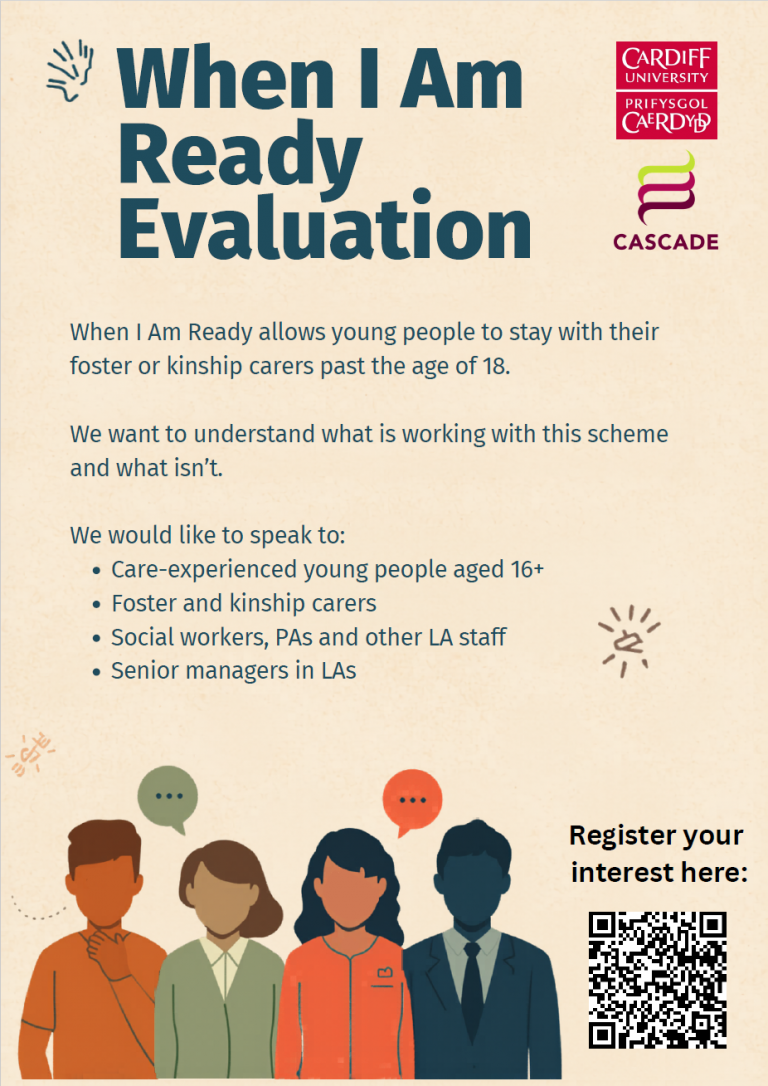
When I Am Ready is a Welsh Government scheme which allows young people to stay with their foster or kinship carers past the age of 18. This research, funded by the Welsh Government, aims to develop a Theory of Change to understand how WIAR operates in theory and in practice, as well as building a clearer picture of the experiences of young people, foster and kinship carers and professionals’ experiences of the scheme.
Overview
The ‘When I Am Ready’ (WIAR) scheme was introduced in April 2016 under the Social Services and Well-being (Wales) Act 2014, enabling young people leaving foster care to remain with their foster or kinship carers beyond the age of 18. The scheme responds to well-documented evidence that the abrupt transition to independent living at 18 can have a damaging effect on care leavers’ outcomes.
Despite the policy’s aims, uptake in Wales has remained persistently low, with fewer than a quarter of eligible young people entering WIAR arrangements. The Children, Young People and Education Committee inquiry found the scheme was “not working effectively or consistently across Wales.” CASCADE’s earlier review of the scheme (Stabler et al., 2023) identified a range of barriers to uptake, including variable awareness and training among professionals, inconsistent support across local authorities, financial disincentives for carers, and a lack of awareness of the scheme among young people themselves.
This evaluation, commissioned by the Welsh Government and building on CASCADE’s earlier review (Stabler et al., 2023), aims to develop a Theory of Change for WIAR, assess how the scheme has been implemented across Wales, understand the lived experiences and perceived outcomes of care leavers and carers, and consider the implications for extending the scheme to age 25 and to residential care leavers.
Activities and Methods
The evaluation is structured around five research questions:
- How was the scheme expected to work and what assumptions underpinned its design?
- How as implementation varied across Wales and what explains this variation?
- What are the barriers to uptake for care leavers and carers and how might these be addressed?
- What are the lived experiences and perceived outcomes for those who have participated?
- What are the implications for extending the scheme to age 25 and to residential care leavers?
The evaluation uses a mixed-methods approach organised into three work packages, supported by public involvement activities throughout.
WP1 (Theory of Change) draws on a policy and literature review, key informant interviews, and workshops with professionals, care-experienced young people and foster carers to develop a shared understanding of how the scheme was intended to work and where practice has diverged from that intent.
WP2 (Process Evaluation) uses interviews with local authority representatives and focus groups with practitioners to assess how the scheme has been implemented across Wales and what helps or hinders delivery.
WP3 (Impact Evaluation) explores the lived experiences and perceived outcomes of the scheme through interviews with care leavers, focus groups with foster carers, and surveys.
Care-experienced young people and foster carers are involved throughout the evaluation via engagement workshops, an advisory group, and CASCADE Voices. Partners include Voices from Care Cymru and The Fostering Network Wales.
Updates
We’re pleased to share an update on CASCADE’s evaluation of the When I Am Ready scheme in Wales.
June Update
The evaluation team has now begun Work Package One, which focuses on developing a draft Theory of Change for the scheme. This work will help us understand how When I Am Ready is intended to operate, the assumptions that underpin it, and where those assumptions may not always translate smoothly into practice. By identifying these points, the evaluation can help highlight where changes or improvements may be needed.
To inform this work, we have been undertaking a desk-based literature review and has also begun key informant interviews. So far, nine interviews have been completed with stakeholders from Welsh Government, third sector and private sector organisations and Local Authorities. These interviews are helping us build a more detailed understanding of how the scheme is currently functioning across Wales.
We have also run two consultation sessions: one with foster carers from The Fostering Network Wales and one with young people from Voices from Care Cymru, to strengthen our understanding of the scheme and help shape the questions we will ask in upcoming interviews and focus groups.
There has already been significant interest in the study. We have written an article for Children in Wales about the importance of evaluating When I Am Ready, which will be released in early July, and have presented to the Children in Wales Children’s Research Network about the scheme and the evaluation.
July Update
The evaluation of the When I Am Ready scheme is continuing to make good progress, with activity taking place across interviews, focus groups, surveys and advisory work.
We have now completed our key informant interviews and have been speaking to Heads of Service, or equivalent senior staff, across Wales. Interviews have been completed or arranged with representatives from 20 of the 22 Welsh Local Authorities. These discussions are helping us understand how When I Am Ready is delivered in different areas and some of the challenges and opportunities associated with the scheme.
Alongside this work, we are developing surveys for young people and foster carers. A draft foster carer survey has been produced, and work is progressing on a survey designed specifically for young people. We are aiming to make the young person survey clear, accessible and engaging, while still collecting the information needed for the evaluation.
Young people are helping to shape this work through an advisory group. Recent sessions have focused on how the survey should look and feel, the types of questions it should include and how it can be made more enjoyable to complete. Their feedback will be used to improve the survey before it is launched more widely.
Over the coming months, we will continue completing interviews, developing and testing the surveys, analysing the information collected and working with our advisory groups. Together, these activities will help build a clearer picture of how When I Am Ready is working across Wales and how the scheme could be strengthened in the future.
We look forward to continuing this work and sharing further updates as the project develops.
Lead Person
| Research Fellow | Dr Rebecca Jones |
Academics and Researchers
| Research Fellow | Dr Lorna Stabler |
| Research Assistant | Emily Baker |
Related Information
| Related Schools | School of Social Sciences, Cardiff University |
| Related partners | CASCADE Voices, The Fostering Network Wales, Voices from Care Cymru |
| Funders | Welsh Government |
| Related documents | Stabler, L. et al. (2023) Review of the ‘When I Am Ready’ scheme. CASCADE, Cardiff University. |